
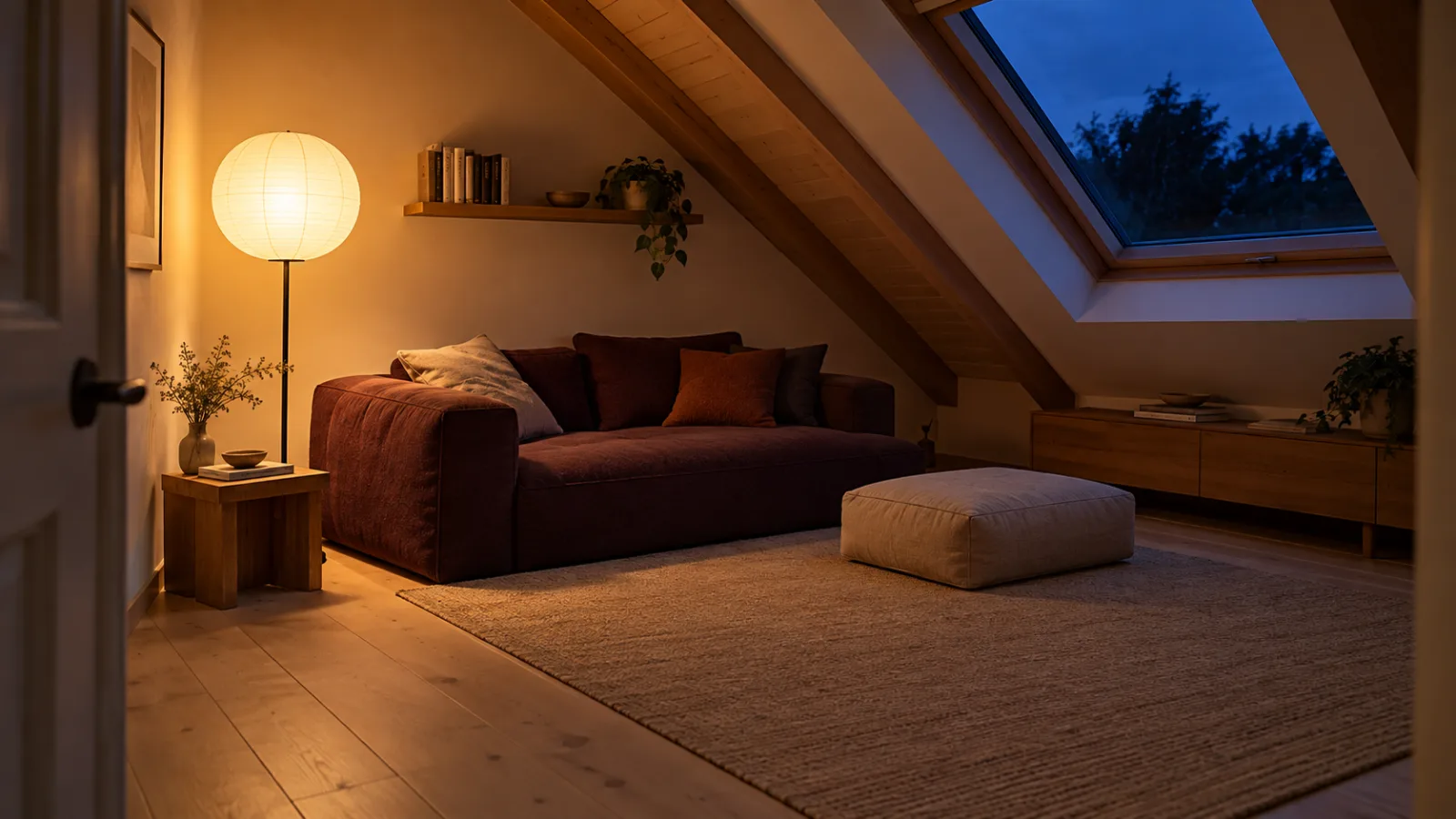
These living room lighting ideas start from a simple point. A living room can feel badly lit even when it has plenty of light. One ceiling light does the whole job, the bulbs don't match, and the reading chair sits in its own shadow.
The fix rarely needs new wiring. It's usually the right bulb, a few lamps at different heights, and each one placed next to something people actually do. This guide covers the bulb numbers worth knowing (2700K–3000K and CRI 90+), how to place floor and table lamps, and how to light a room that has no ceiling light at all. Lighting is also the cheapest of our cozy living room ideas, which is why it comes first there too.
If you only have a few minutes, start with bulb color in section 1 and lamp placement in section 5.
In this article
- 1. Best Light Bulb Color for a Living Room
- 2. Warm White vs Cool White for a Living Room
- 3. Check CRI and Lumens, Not Just Watts
- 4. Plan Three Layers of Light
- 5. Floor Lamp Placement in a Living Room (and Table Lamp Height)
- 6. Choose the Shade for Where the Light Should Go
- 7. Living Room Lighting Without a Ceiling Light
- 8. How Many Lamps in a Living Room?
- 9. Add Dimmers, Then Test the Room After Dark
- Final Thoughts
- Frequently Asked Questions
1. Best Light Bulb Color for a Living Room
For most living rooms, warm white at 2700K–3000K is a good starting point. It gives the room a warm, comfortable look after dark without turning everything orange.
Color temperature is measured in kelvin (K) and printed on the box or the bulb itself. Lower numbers look more amber. Higher numbers look whiter and bluer. Roughly, 2200K–2700K is very warm, like a dimmed filament bulb. 2700K–3000K is warm white. 3500K–4000K is neutral white, the kind often used in kitchens and offices. 5000K–6500K is daylight, crisp and slightly blue.
Within the warm-white range, 2700K looks softer and a little more golden, while 3000K looks a touch cleaner without turning cold. Either works, and the choice is more about style than rules. 2700K often sits well with wood, rust and olive tones. 3000K can feel cleaner alongside cooler grays, whites and blues. If you're unsure, start with 2700K in the lamps you use in the evening.

2. Warm White vs Cool White for a Living Room
A bright 5000K–6500K ceiling panel is easy to live with at noon. At 10 pm, the same light can make a living room look like a clinic waiting area.
The warm white vs cool white question for a living room doesn't have to be all or nothing. Cool white helps where you need detail, like a desk corner. Warm white suits common evening activities such as conversation, relaxing and watching movies.
If your living room already has a cool ceiling light, you don't need to replace it. Keep it for cleaning and daytime tasks, and switch to a few warm lamps after sunset. That split suits hot climates, where cool light can feel fresher during the day. In cooler, grayer climates, the problem runs the other way. Winter afternoons get dark early, and warm lamps are welcome from mid-afternoon.
If possible, avoid mixing very different color temperatures in the same view. A 2700K table lamp next to a 6500K ceiling panel makes the difference obvious. The lamp looks orange, and the ceiling looks blue. If you can see two lights at once, keep them in the same range, ideally the same color temperature.
3. Check CRI and Lumens, Not Just Watts
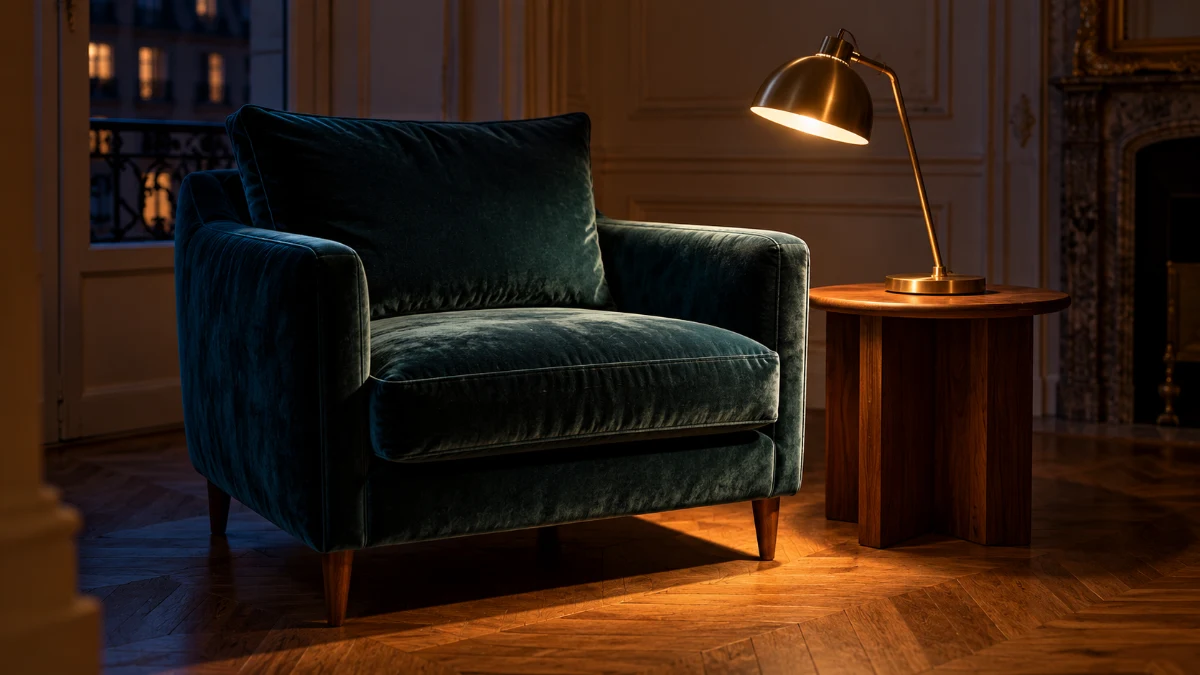
A bulb can look fine in the store and still make a teal armchair look gray at home. That's usually color rendering, not color temperature.
CRI, or Color Rendering Index, rates how accurately a light shows colors, on a scale up to 100. Many standard LED bulbs sit around 80. For the lamps that light your main seating, aim for CRI 90 or higher, so wood, upholstery, artwork and painted walls look closer to how they do in daylight.
California's residential lighting standard also uses CRI 90+ for applicable light sources (California Energy Commission). That makes it a useful quality benchmark to look for when buying bulbs, not a rule.
Brightness is measured in lumens, not watts. An old 60 W incandescent bulb gave about 800 lumens (ENERGY STAR), and an LED now gives the same light on a fraction of the power. 800 lumens is a useful reference point when comparing bulbs, although how much you need depends on the shade, the distance and the task.
| What to check | Starting point for a living room |
|---|---|
| Color temperature | 2700K–3000K (warm white) |
| Color rendering | CRI 90+ |
| Brightness reference | 800 lumens ≈ old 60 W bulb |
| Table lamp shade | Bottom edge near seated eye level |
| Dimming | "Dimmable" bulb plus a compatible dimmer |
You don't necessarily need CRI 90+ everywhere. It's most useful in lamps that light seating, artwork and other colors you want to see accurately. Paint also shifts under different bulbs, which is why the guide to living room color schemes suggests testing samples under your own lamps.
4. Plan Three Layers of Light
Picture a living room lit only by one ceiling light in the middle. Everything is evenly bright, the corners are gray, and faces look flat.
Lighting designers split a room's light into three layers. Ambient light lets you move around safely and see the whole room. Task light is brighter and aimed at one job, like reading or a puzzle on the coffee table. Accent light is a small pool that picks out a shelf, a plant, a textured wall or a picture, and gives the eye somewhere to rest.
The layers describe jobs, not fixtures. A paper-shade floor lamp beside the sofa can do ambient and task at once. A table lamp on a sideboard can light that end of the room while picking out the vase beside it. What matters is that light comes from several places at different heights, not one point overhead.
5. Floor Lamp Placement in a Living Room (and Table Lamp Height)
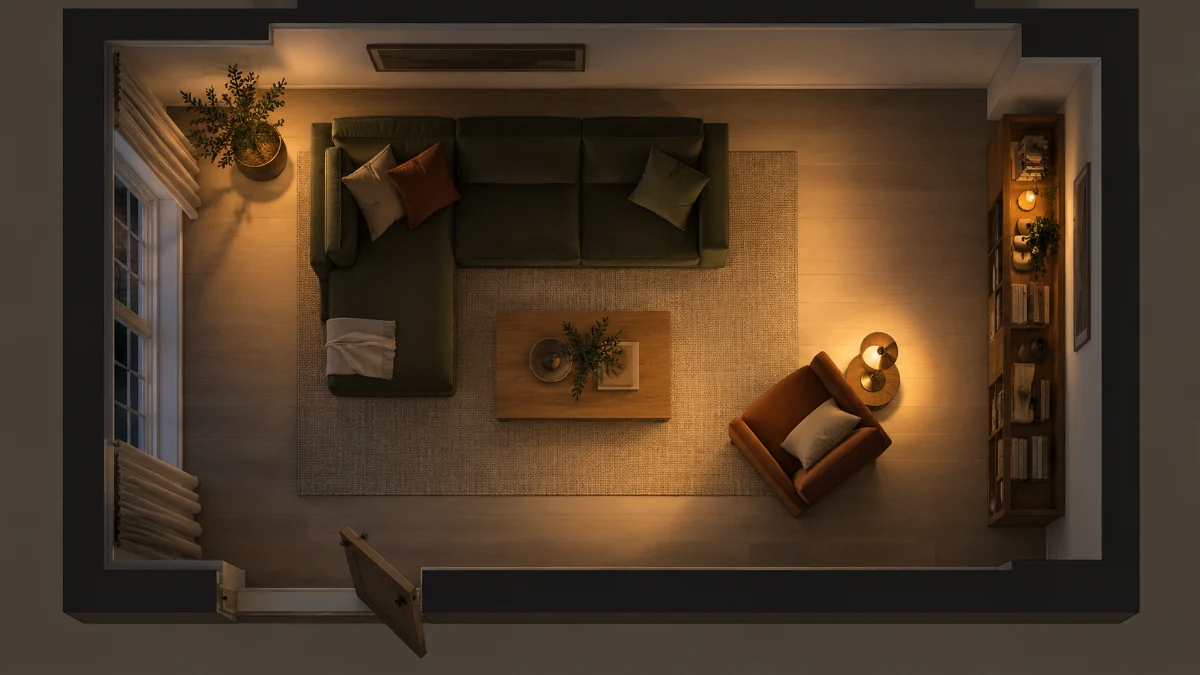
Place a floor lamp beside or slightly behind the seat it serves, with the shade just above shoulder height when you're sitting. That way, light falls over your shoulder onto the page rather than into your eyes.
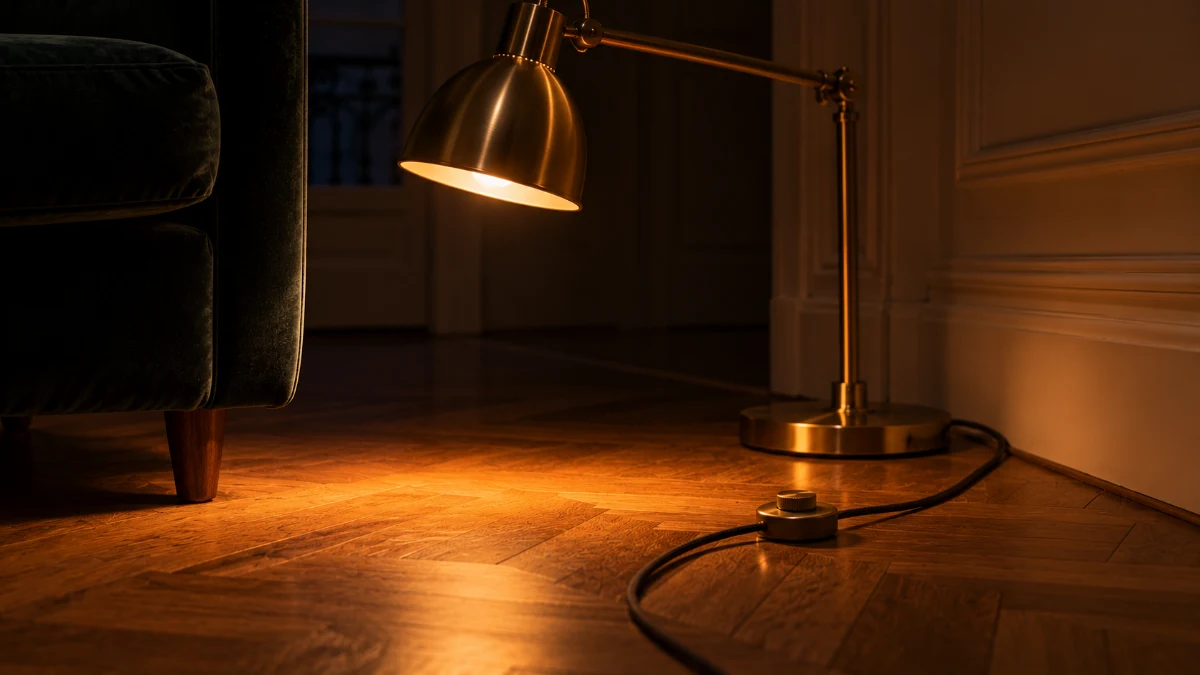
Start with where people actually sit, not with the empty corner. If one end of the sofa is everyone's reading spot, the lamp goes there. For a reading chair, an adjustable or arched lamp, like a brass reading lamp with a swing arm, lets you bring the light over the book. Placing the lamp on the side away from your usual reading hand can help reduce shadows on the page.
Keep the base out of the walkway. A lamp in the main route gets knocked, and its cord becomes a trip hazard. The furniture layout guide covers walkway widths. Run cords along the wall or under the edge of the rug rather than across a path.
Table lamps: shade at seated eye level
For a table lamp next to a sofa, the bottom of the shade should sit around seated eye level. For many sofa-side setups, that works out at roughly 100–107 cm (39–42 in) from the floor. Furniture heights vary, though, so treat it as an example rather than a standard.
The quickest test needs no tape measure. Sit where you normally sit, look at each lamp and check whether you can see the bare bulb. If you can, lower the shade, swap the lamp or move it. A visible bulb is one of the most common reasons a room feels glary.
6. Choose the Shade for Where the Light Should Go
Lamps are usually chosen for how they look switched off. The shade decides how they behave switched on.
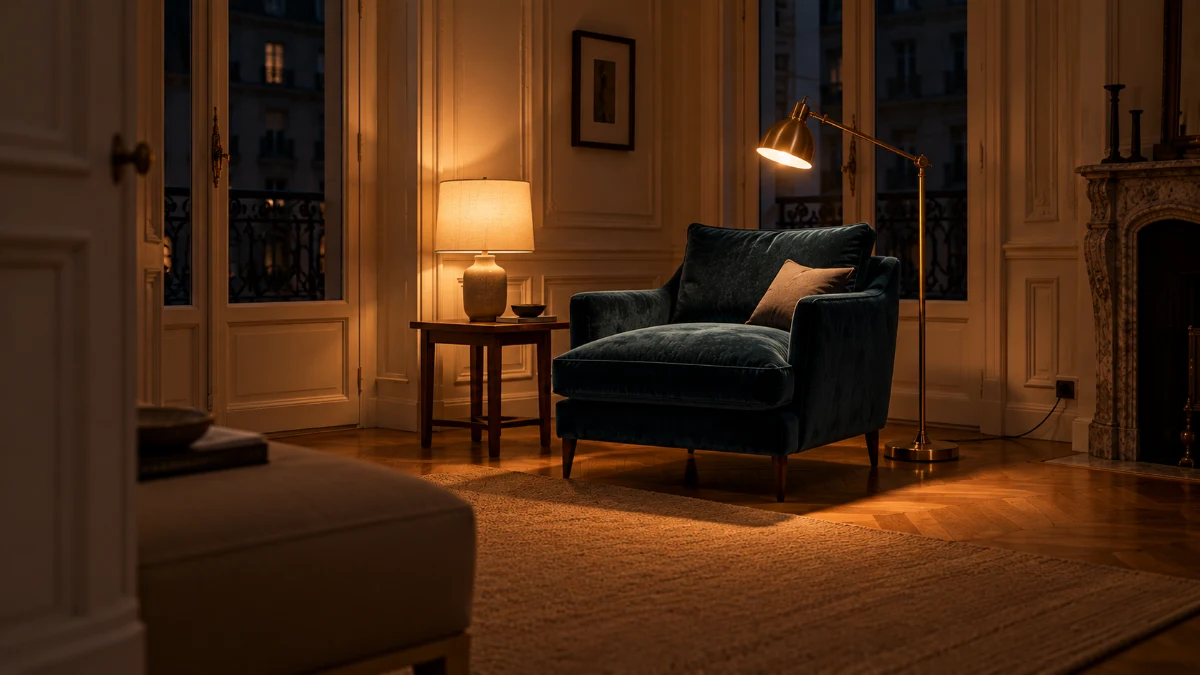
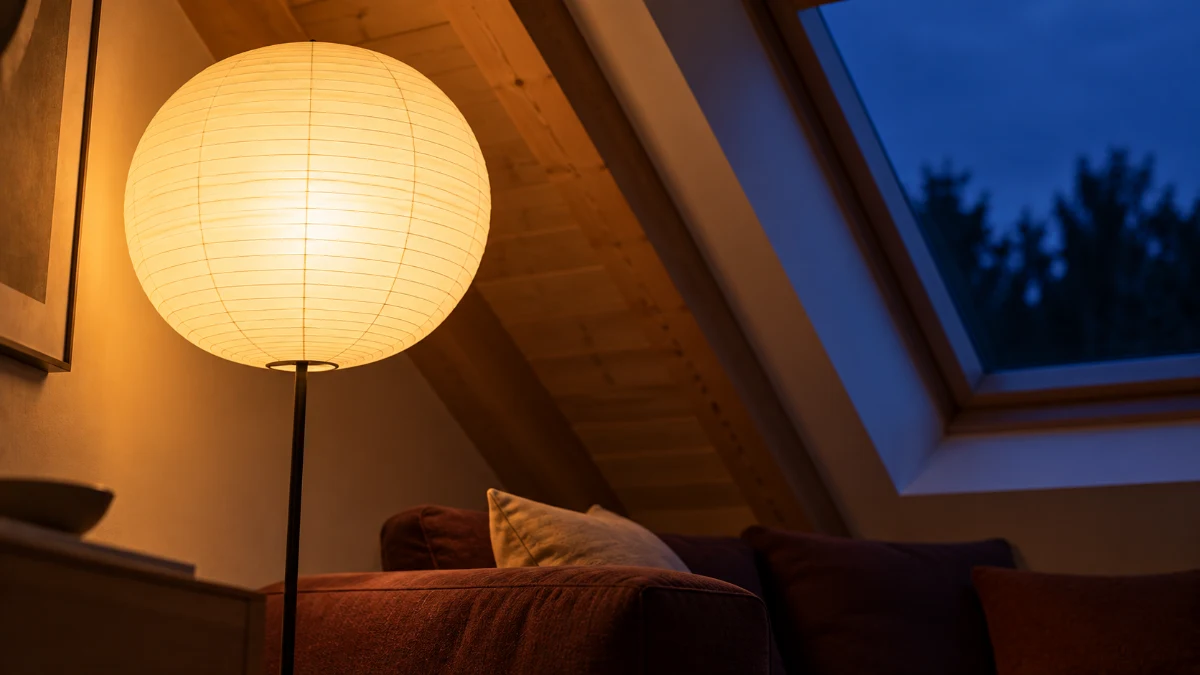
A paper or thin linen shade glows all over and spreads soft light through the room. It's good for ambient light and for evenings, because it hides the bulb completely. A paper-shade floor lamp sits naturally in a Japandi living room, and it suits almost any room with wood and linen in it.
An opaque shade, like a brass or enamel dome, does the opposite. It throws a defined pool of light down or sideways and leaves the rest of the room alone, which is what you want over a book. An open-top drum shade sits in between. It sends light both down and up, which helps in a room with a pale ceiling.
In hot, humid homes, paper and thin fabric shades may need more care, particularly near open windows. Look for sturdy construction, and keep natural-fiber shades away from direct moisture. The guide to furniture for a humid climate covers materials for damp homes.
7. Living Room Lighting Without a Ceiling Light
To light a living room without a ceiling light, spread several lamps around the room instead of relying on one. Start with one by the main seating and another on the far side. Add a third wherever the room stays dark, and let at least one bounce light up onto the ceiling. The same approach works for living room lighting without overhead lights you'd rather not use.
The usual mistake is buying one very bright floor lamp and expecting it to fill the room. It lights one side well and leaves the other in shadow. You don't need one powerful lamp. You need light coming from several places.
Start with the ceiling, even though there's no fixture on it. An uplighter, or a floor lamp with an open-top shade, reflects off a pale ceiling and gives a soft general glow. It's the closest thing to a ceiling light without any wiring.
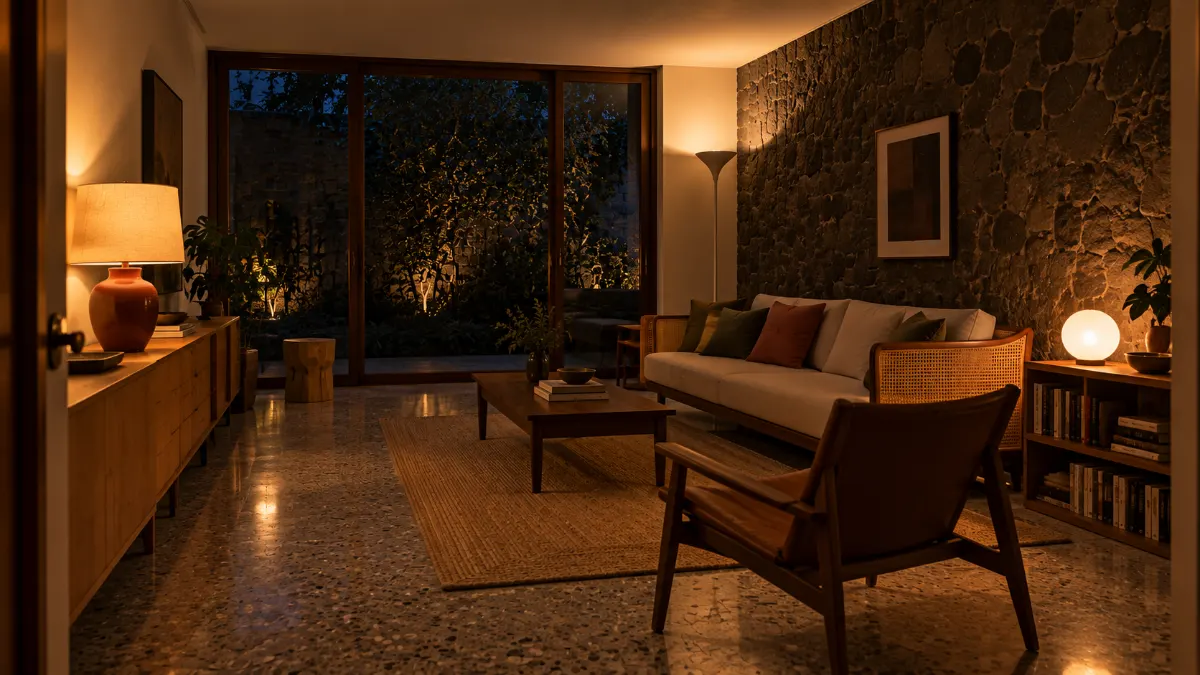
Then work across the room. A table lamp on a console or sideboard on the far side balances the light, so the seating area isn't a bright island in a dark room. A smaller lamp near a chair or on a shelf fills whatever is left. Plug-in wall sconces are another option. They hang like a picture and plug into an outlet, which keeps tabletops free in a small apartment or rental. For more changes that don't need wiring or drilling, see our renter-friendly living room ideas article.
8. How Many Lamps in a Living Room?
There's no fixed number. Count the jobs that need light, then give each one a light source. A small room may need two or three lamps. A larger one may need several more.
The jobs are usually reading, talking, watching TV, working at a desk and moving through to the rest of the home, plus any corner that stays dark. Each needs light nearby. Large rooms and dark walls or floors push the number up. A pale ceiling with a good uplighter, or a small room where one lamp covers two activities, brings it down.
The mistake to avoid is buying lamps to fill empty corners. Two well-placed lamps and one accent light can feel better lit than five that all do the same job.
9. Add Dimmers, Then Test the Room After Dark
A living room needs very different light at 7 pm with guests and at 11 pm with a movie. Dimming lets the same lamps cover both.
Not every LED works with every dimmer. Buy bulbs marked dimmable, and check the bulb maker's compatibility list before installing a wall dimmer. A mismatch can cause flicker, buzzing or bulbs that won't dim low. For lamps, an inline cord dimmer or a dimmable smart bulb needs no wiring at all. Dim-to-warm bulbs turn more amber as they dim, which suits late evenings.
Then check the room the way it's actually used, after sunset. Sit in your usual seat with the lamps on and look for:
- Dark patches. One side of the room much darker than the other, or a route to the kitchen with no light on it.
- Glare. A bare bulb in view, or a lamp reflecting in the TV screen. The guide to TV wall ideas covers TV placement and screen glare.
- Mismatched color. One lamp clearly more orange or more blue than the rest.
Before buying another lamp, try moving the ones you have. Shifting one from behind the sofa to beside it often fixes more than a new lamp would.
Final Thoughts
Good living room lighting comes from a few small choices made well: matching warm bulbs, light at different heights, and each lamp placed beside something people actually do.
Start here: tonight, after sunset, switch off the main ceiling light and turn on the lamps you actually use. Sit in your usual place and look for glare, dark patches and mismatched bulb colors. Move the lamps before you buy another one.