
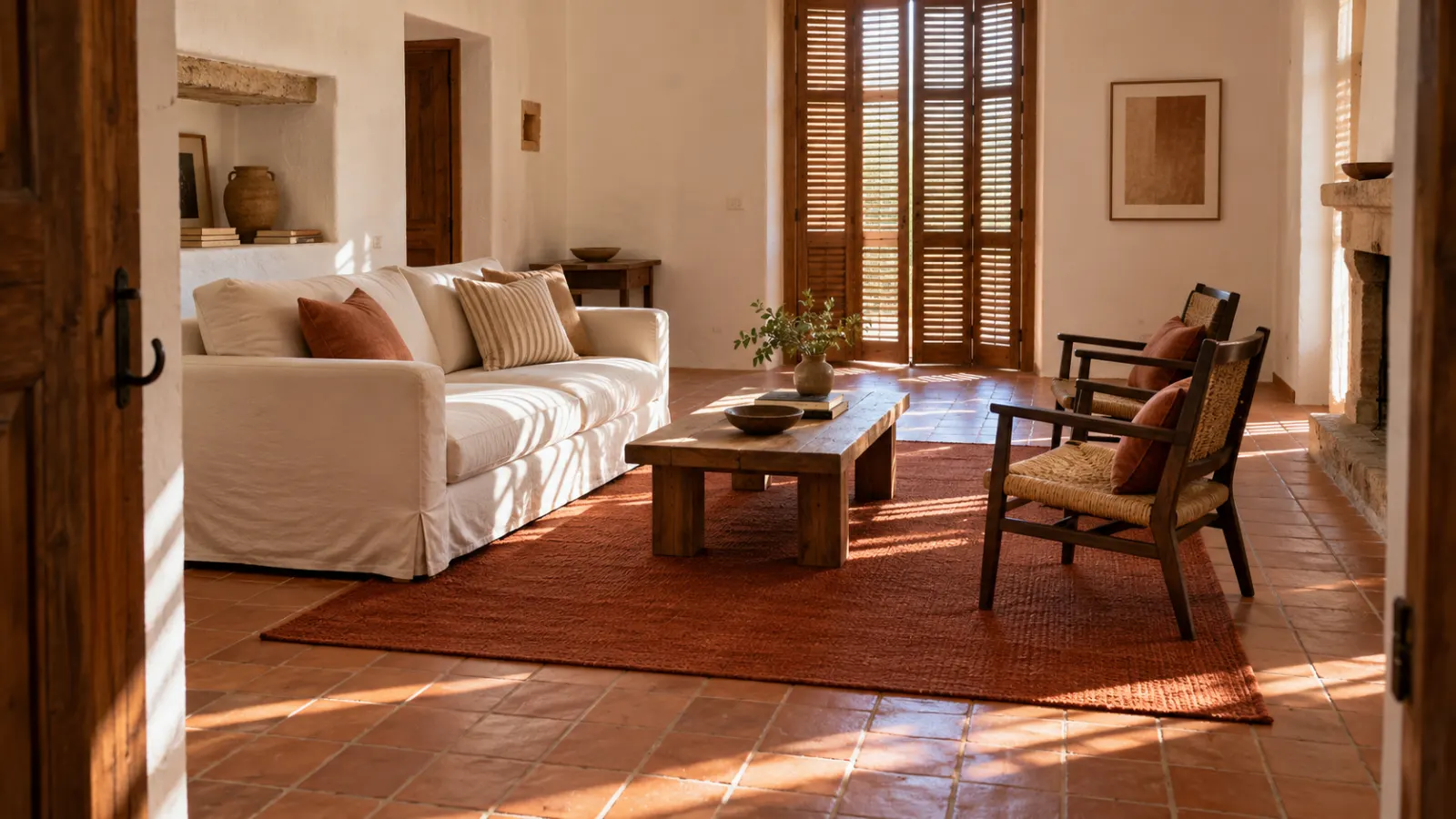
The right living room rug size decides whether your sofa, chairs and coffee table look like one group, or like furniture that just happens to share a room. A common mistake is buying for the empty floor instead of for the seating that will sit on the rug.
Then come the other questions. Should the sofa sit on it? How much floor should you leave at the walls? Which fiber should you pick, and what goes underneath? In a humid home, that last one matters more than most guides admit, because a rug can look fine on top and stay damp underneath for days.
If you're about to order, start with the size chart in section 1 and the quick floor test in section 4. Together they catch most sizing mistakes.
In this article
- 1. What Size Rug for a Living Room? Start With the Seating
- 2. Should the Sofa Sit on the Rug?
- 3. How Far Should a Rug Be From the Wall?
- 4. Test the Size on the Floor Before You Buy
- 5. Rugs for Sectionals, Round Seating and Open-Plan Rooms
- 6. Living Room Rug Size for Small Rooms
- 7. Best Rug Material for a Living Room: Wool, Jute or Synthetic
- 8. Flatweave or Pile?
- 9. Do You Need a Rug Pad?
- 10. Rugs in Humid Homes: Watch the Underside
- Final Thoughts
- Frequently Asked Questions
1. What Size Rug for a Living Room? Start With the Seating
For most living rooms, an 8×10 ft rug (about 240×300 cm) is the usual starting point. Compact seating often suits 5×7 or 6×9 ft, while big rooms and sectionals usually need 9×12 ft or more. The right size is the one that connects your main seating, not the one that covers the most floor.
So measure the whole seating group first, not the sofa alone. That means the sofa, the chairs on either side and the coffee table in between. As a minimum, let the rug run past both ends of the sofa rather than stopping at its arms. Many rug guides suggest about 15–20 cm (6–8 in) at each end. If chairs sit beside the sofa, the rug needs to be wider still.
| Seating setup | Rug size (ft) | Approx. size (cm) |
|---|---|---|
| Compact sofa or loveseat with a coffee table | 5×7 | 150×210 |
| Sofa with one or two small chairs | 6×9 | 180×270 |
| Sofa, chairs and coffee table in a medium room | 8×10 | 240×300 |
| Large sofa or sectional plus chairs | 9×12 | 270×360 |
| Large open-plan seating zone | 10×14 | 300×420 |
Treat this as a rug size guide for the living room, not a rulebook. Rugs sold in Europe often come in metric sizes like 160×230 or 200×300 cm, so compare real dimensions, not labels. Stuck between two sizes? Tape out both before buying. The larger one often works better when it keeps the seating connected without crowding the walls.
2. Should the Sofa Sit on the Rug?
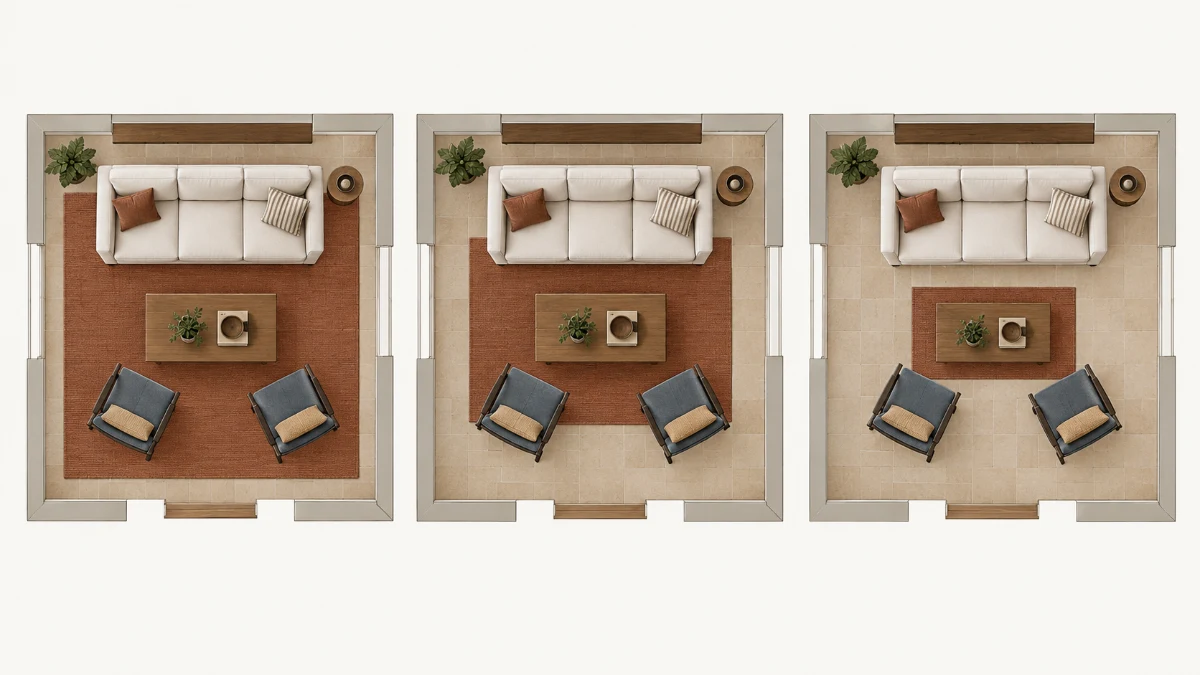
Usually yes, at least the front legs. There are three common types of living room rug placement.
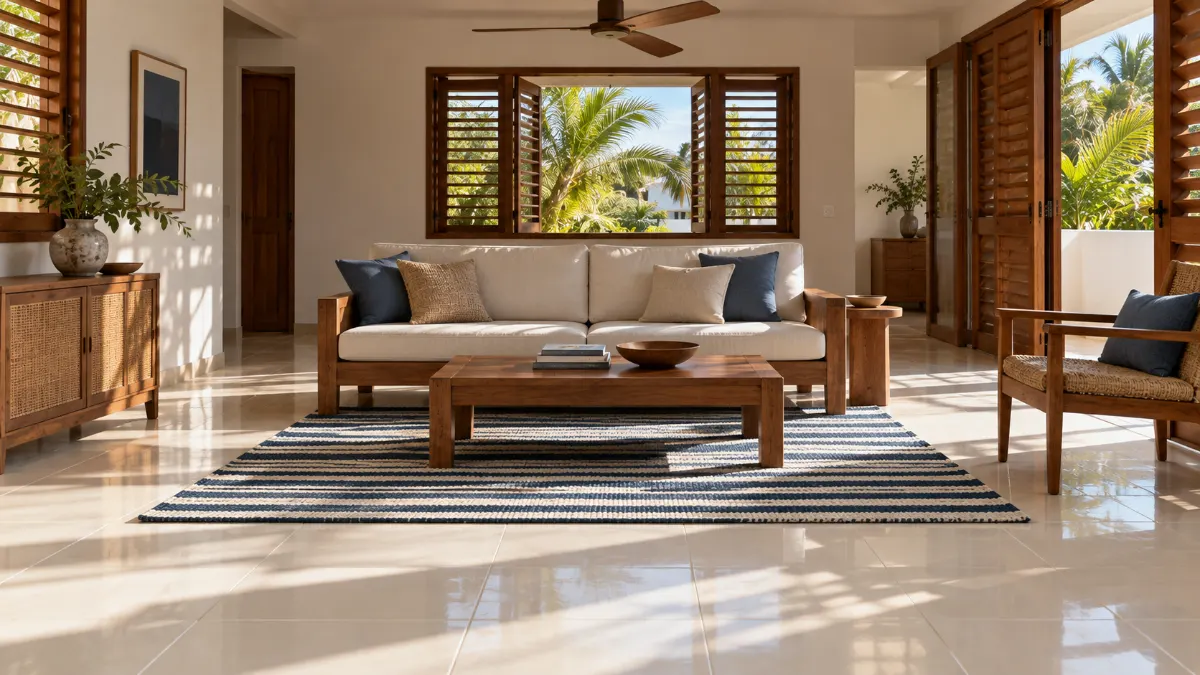
All legs on gives the strongest sense of one zone. Every seat sits fully on the rug, which usually means 9×12 ft or larger and a room big enough to still show floor around it. It's the natural choice in open-plan spaces, where the rug does the job a wall would do.
Front legs on is the most flexible. The rug reaches a little past the front legs of the sofa and chairs, so they don't perch on the edge, while the back legs stay on the floor. It suits a sofa against the wall and most medium rooms.
Only the coffee table on can work in a small room with a 5×7 ft rug, but only if the seating sits right at its edge. When a strip of bare floor separates the sofa from the rug, the rug stops looking like part of the group and starts looking like a mat.
Whichever you choose, keep the rug square to the seating.
3. How Far Should a Rug Be From the Wall?
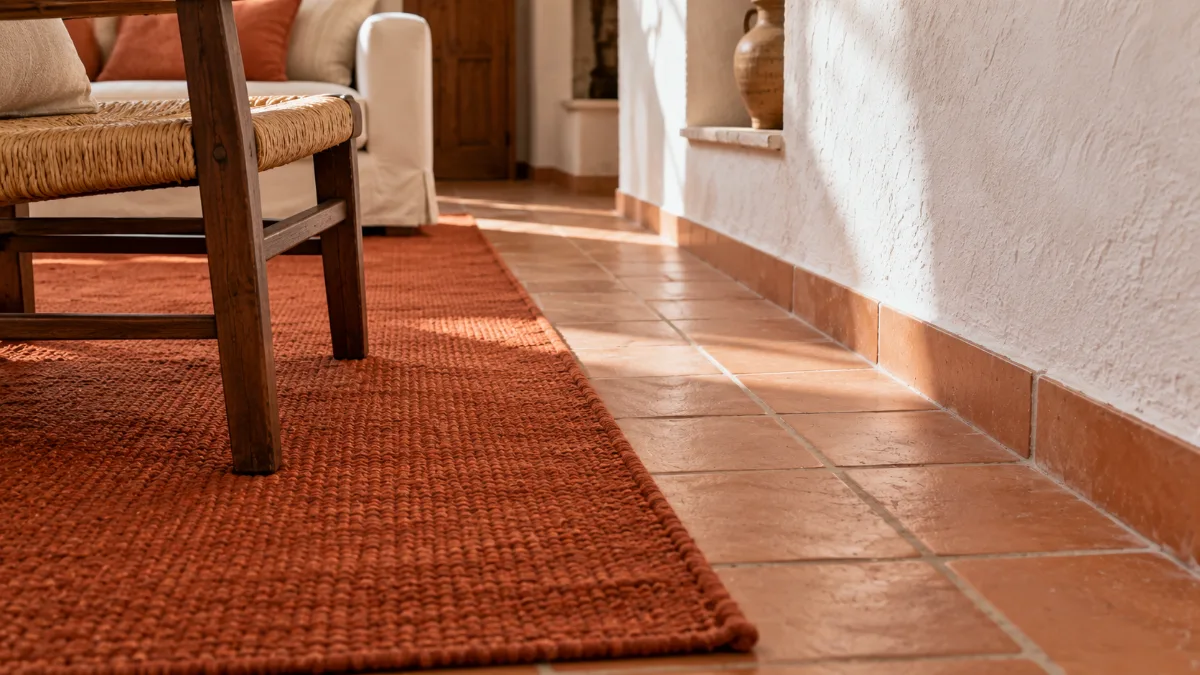
Leave a visible border of bare floor. Most guides land on about 30–45 cm (12–18 in) in an average living room. Small rooms can go down to around 15–20 cm (6–8 in), and large rooms can take 60 cm (24 in) or more.
Consistency matters more than the exact number. A roughly even border looks planned, while a rug almost touching one wall with a wide gap at the other looks like it slid there. If it nearly meets the walls on every side, it starts to look like carpet that didn't quite fit, so size down.
Center the rug on the seating, not on the room. With a sofa against the wall, the rug follows the furniture forward, and the border behind the sofa barely matters. In open-plan rooms, the rug may not reach any wall at all. There, its edge marks the living area, so keep the main walkway beside it clear. Walkway widths are covered in the guide to arranging living room furniture.
4. Test the Size on the Floor Before You Buy
Product photos make scale hard to judge. A rug that looks generous online can feel small under a real sofa, and an 8×10 can swallow a compact apartment. Ten minutes with tape settles it.
Measure these first:
- Sofa width and depth, plus any chairs that should touch the rug
- Coffee table length and width
- The distance from the sofa front to the facing chairs
- Room width and length, and where each door opens
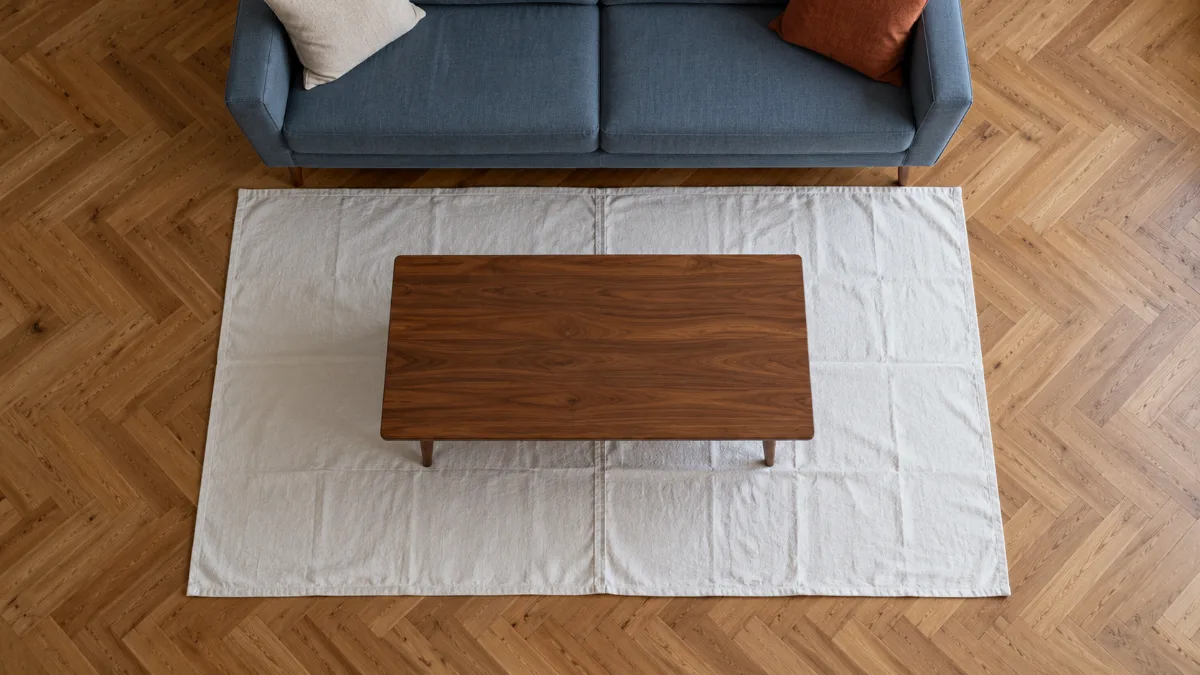
Then mark the outline of the rug size you're considering with painter's tape, flattened cardboard or bedsheets folded to size. Put the furniture back where it normally sits.
Look for three things. The legs should land where you planned, not on the very edge. The coffee table should have rug showing on all sides, not sit on it like a placemat. And the border to the walls should look even from the doorway. Open every door nearby too, including any patio or balcony door, to check nothing catches.
If the furniture seems to squeeze in around a 5×7 outline, try the next size up before moving a single chair closer.
5. Rugs for Sectionals, Round Seating and Open-Plan Rooms
Sectionals break most rug charts, because an L-shape is wide in two directions at once. The front-legs rule still applies, but along both runs of the sofa. If the rug only reaches the long side, the chaise ends up hanging off, and the whole group looks lopsided. Measure each arm of the L, let the rug run past both ends, and expect to land on 9×12 ft or larger for a big sectional.
Open-plan rooms have the opposite problem: too much floor. One larger rug pulls a scattered group together better than two small ones, and its edge marks where the living area ends. Keep dining chairs off it, since chairs dragged across a rug edge wear it fast.
Round rugs suit a compact, fairly symmetrical group around a round coffee table, or a room full of straight lines that needs softening. For the chairs and sofa to reach it, a round rug usually needs to be at least 8 ft (about 240 cm) across.
6. Living Room Rug Size for Small Rooms
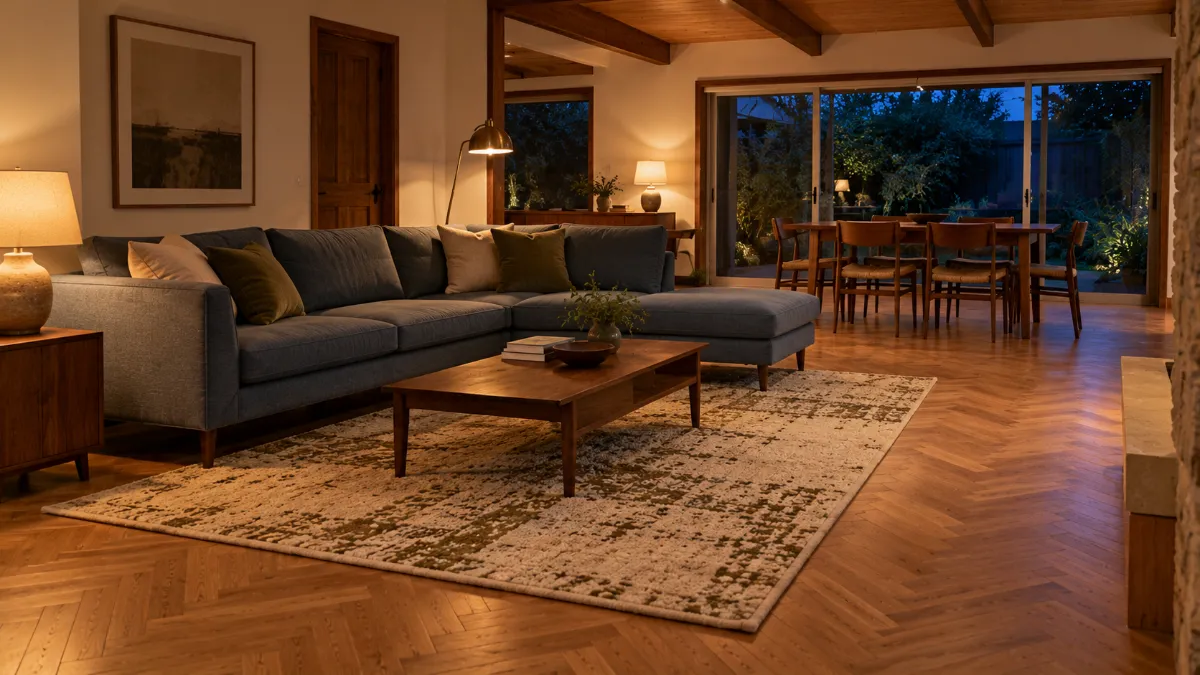
In a small living room, size the rug to the seating. That often means 6×9 ft rather than 5×7, with only the front legs on.
It's tempting to go small to keep the room open. But a little rug floating in the middle cuts the floor into pieces and can make the room look busier, not bigger.
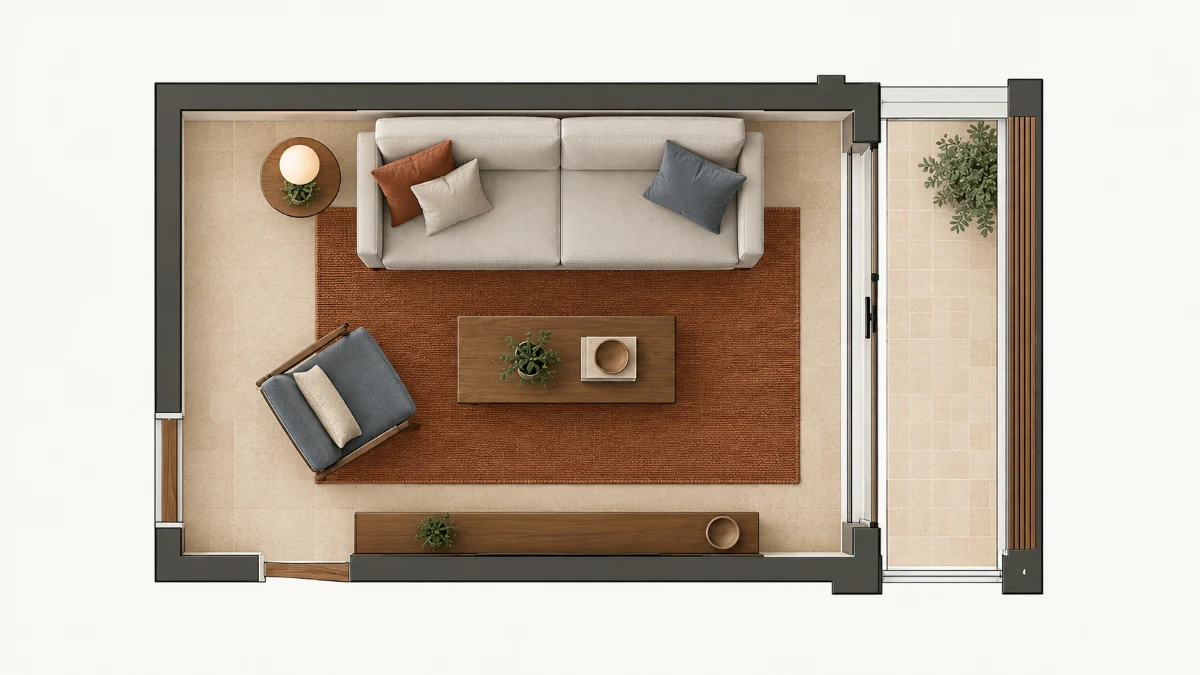
A 5×7 ft rug still has its place, under a loveseat and coffee table, or anchoring a reading chair in a corner. In apartments, keep the rug clear of a sliding door's track. In a studio, the rug is also an easy way to mark where the living area ends and the bedroom begins. Our studio apartment layout ideas article show how to do it. For small-space furniture and layouts, see small condo living room ideas.
7. Best Rug Material for a Living Room: Wool, Jute or Synthetic
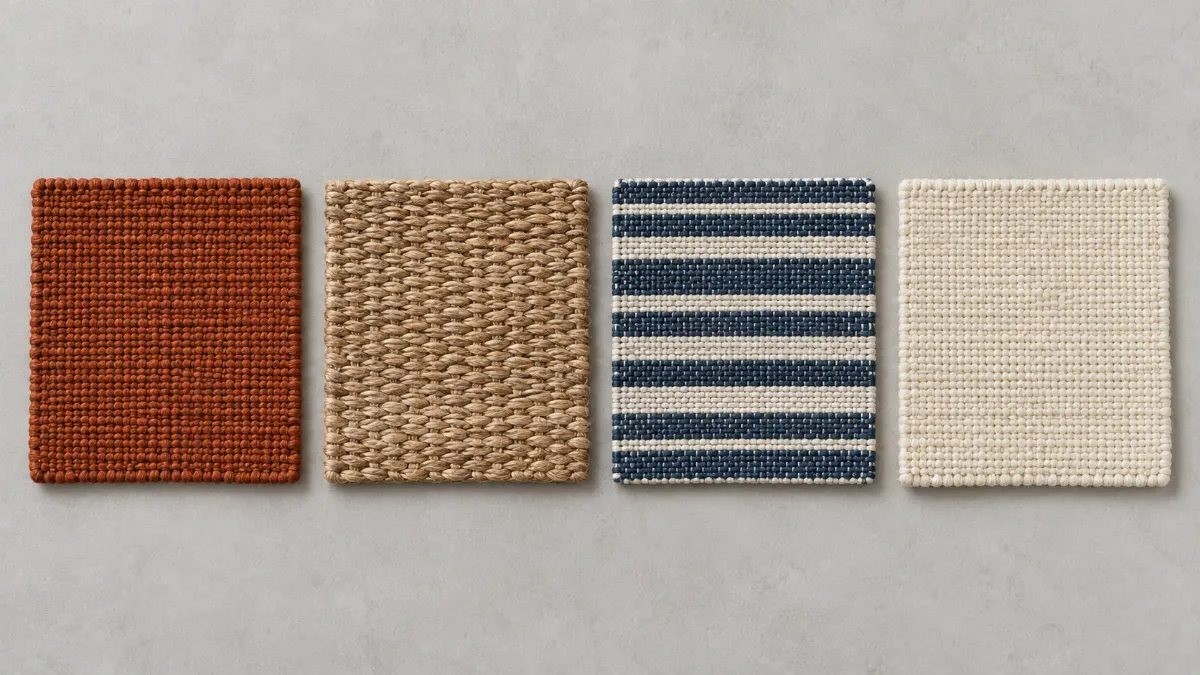
There isn't one best rug material for a living room. Wool suits comfort and long life. Synthetics suit spills and humidity. Jute brings texture to dry, quieter rooms.
Wool is resilient, so it springs back under sofa legs and footsteps, and it takes color well. Its fibers can take up roughly a third of their own weight in moisture vapor (IWTO), which helps it feel comfortable across seasons. That's vapor, though, not water. A soaked wool rug still needs proper drying, away from direct heat and sun. Expect a higher price and some shedding in the first months.
Jute and sisal have a dry, earthy texture and are widely available in large sizes, usually for less than wool. The trade-offs are a coarse feel underfoot and a fiber that soaks up water readily. Wet cleaning can leave brown marks, and a jute rug that stays damp can mildew. It's best in dry rooms with few spills.
Synthetics vary a lot. Polypropylene absorbs very little water, which makes it useful in moisture-prone rooms. But the finished rug still depends on its backing and construction. Some are made for outdoor use or wet cleaning, and others aren't. Polyester is soft and holds bright colors but can mat, and nylon is usually chosen for wear resistance. Read the label for fiber, backing and cleaning method, rather than trusting the word "synthetic".
Cotton flatweaves are light and often washable in small sizes, but thin. For choosing the rug's color, see the guide to living room color schemes. For mixing it with other textures, see the modern cozy living room guide.
8. Flatweave or Pile?
Construction matters as much as fiber.
Flatweaves have no raised pile. They sit low, clear doors easily, vacuum quickly and dry faster after cleaning. They also feel cooler underfoot, which suits warm climates and chairs that get pulled in and out.
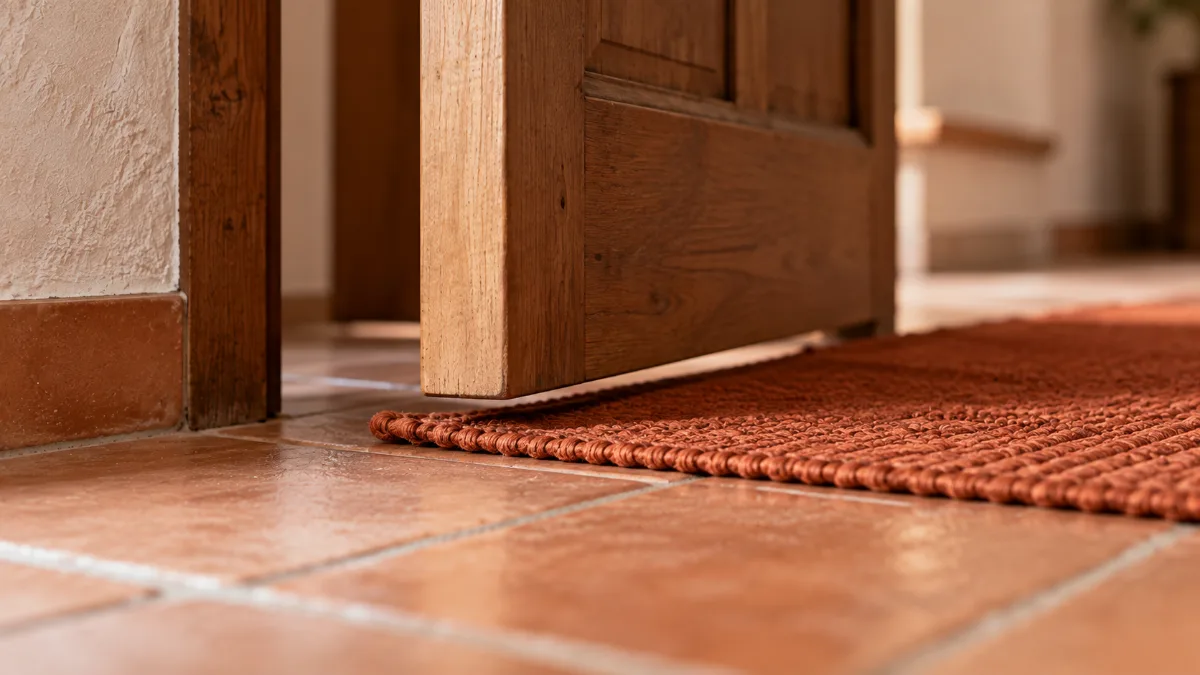
Pile rugs are softer and quieter, and nicer if people sit on the floor. In cooler climates, they add welcome warmth over cold tile or concrete. The trade-off is more dust held in the pile, longer drying time and a thickness that can catch doors and trip feet at the edges.
Before buying a thick rug, open every door that swings over its outline, cabinets included.
9. Do You Need a Rug Pad?
Usually, yes. A pad stops the rug sliding, adds cushioning and reduces wear. Cut or buy it about 2.5 cm (1 in) smaller than the rug on each side, so it stays hidden.
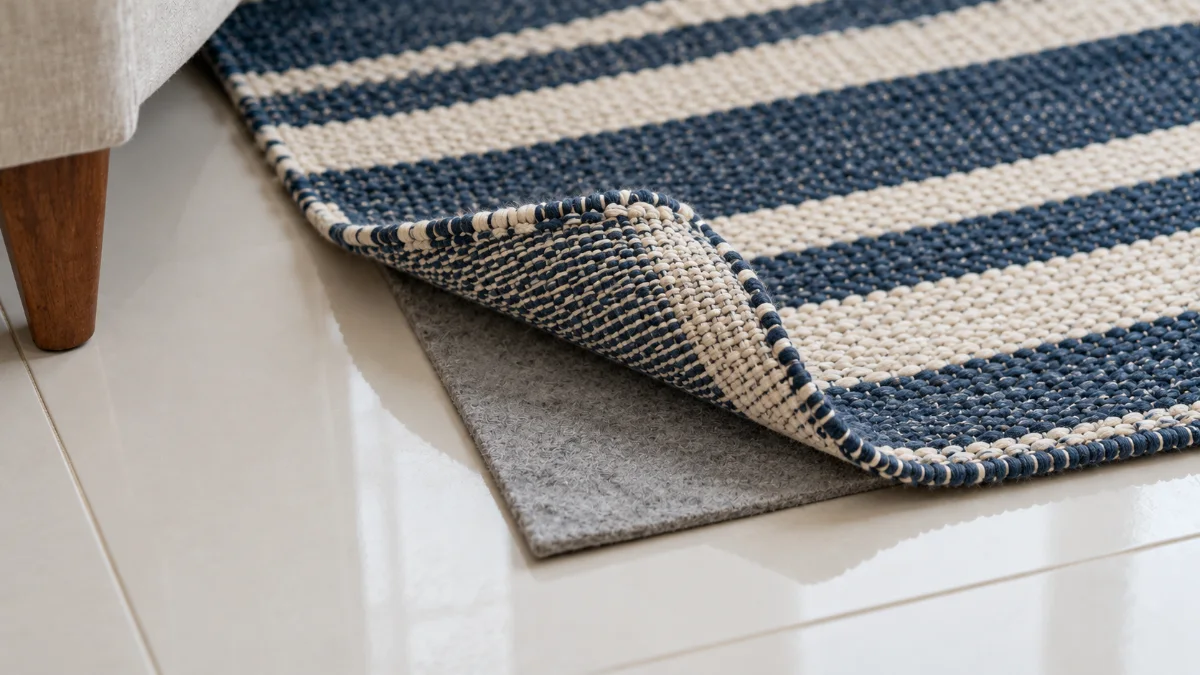
The pad material should suit the floor. Pads and backings made from rubber, latex or some PVC compounds can contain plasticizers that discolor vinyl and wood finishes over time. Felt or felt-and-natural-rubber pads are a common choice for wood floors, and vinyl floors need a pad labeled vinyl-safe. Tile and stone are less fussy, but smooth glazed tile is where rugs slide most, so grip matters there.
Check the floor manufacturer's care guide, since some name the pad types they allow. In humid homes, an open-weave or breathable pad lets moisture escape better than a solid rubber sheet.
10. Rugs in Humid Homes: Watch the Underside
In humid homes, rug problems can start underneath, where trapped moisture is harder to notice. That includes homes with long, humid summers, coastal homes, ground-floor apartments and basements. Mop a tile floor, put the rug straight back, and the moisture has nowhere to go.
The US Environmental Protection Agency recommends keeping indoor humidity below 60%, ideally 30–50%, and drying wet materials within 24–48 hours to prevent mold (EPA). In a humid summer, or in a room without air conditioning or a dehumidifier, indoor air can stay above that for weeks. So the routine matters as much as the rug.
Let the floor dry completely after mopping before the rug goes back. Every few weeks, lift a corner and check for a musty smell, dark spots or a damp backing. After a spill or a leak, lift the rug and dry both sides with a fan, rather than blotting the top and leaving it. Keep rug edges away from air conditioner drips and doors that let rain in. On ground-floor concrete slabs and in basements, which can hold moisture, a low-pile synthetic flatweave made for easy cleaning is worth considering.
In cold climates, the same check helps near cold outside walls, where condensation can collect in winter. For sofas, wood and rattan in damp homes, see the guide to furniture for a humid climate.
Final Thoughts
A rug that fits the seating can make a room look finished, even if everything else is simple. One that fits only the floor rarely does.
Start here: measure your seating group, mark the rug size you're considering on the floor with tape, and see where the sofa and chairs actually land.