
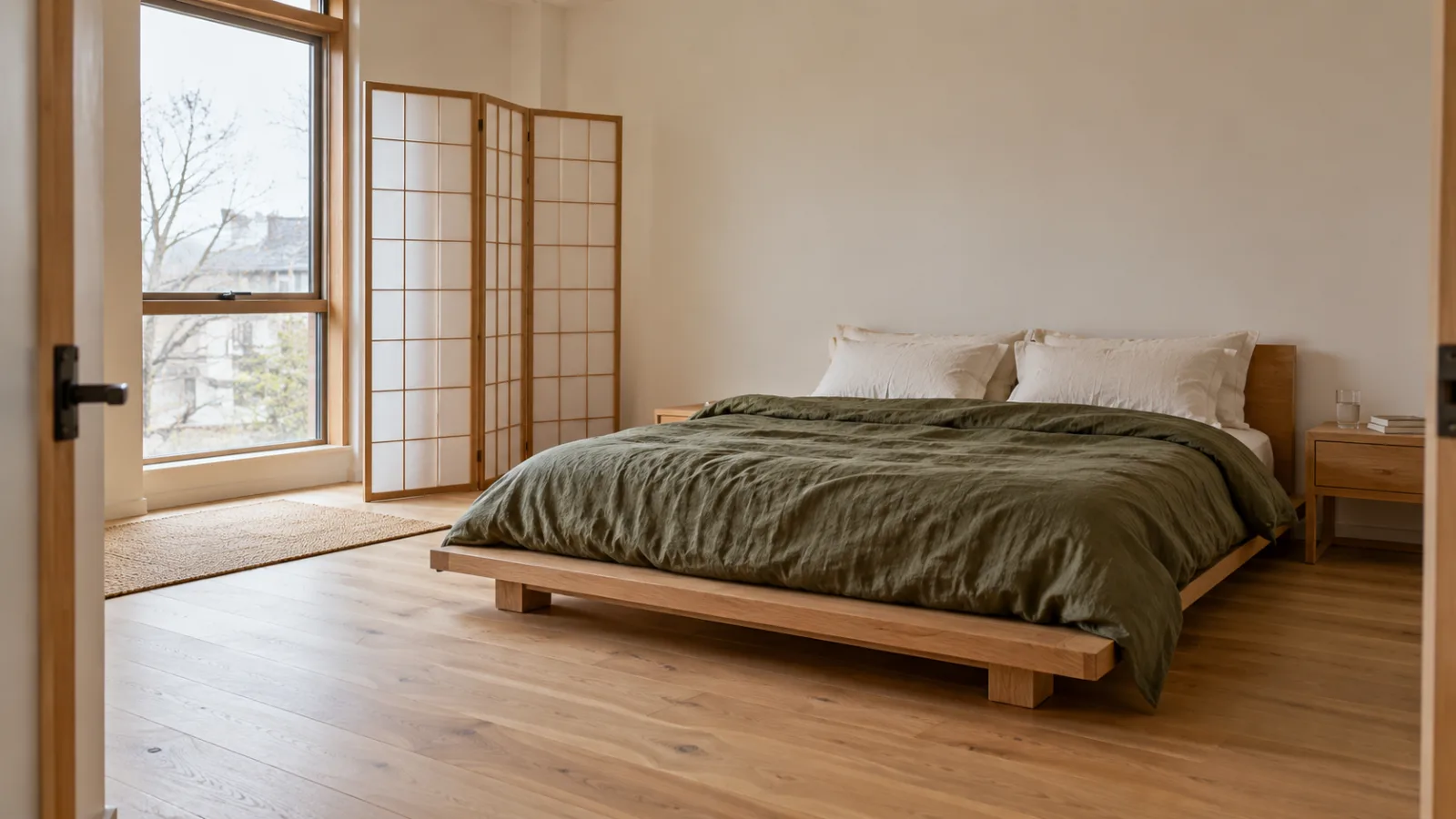
Japandi bedroom ideas usually start with the bed. Think of a low wooden frame, plain bedding in natural fabrics, and very little else in the room. The style suits a bedroom well, because a bedroom's main job is rest.
The tricky part is the bed itself. A very low bed means a small squat every morning. Cleaning underneath gets harder, and in a humid room the mattress may struggle to dry out. But a standard-height bed can lose the close-to-the-floor look that drew you to Japandi in the first place.
If you're choosing a bed right now, start with bed heights in section 1 and humid rooms in section 4.
In this article
- What Is a Japandi Bedroom?
- 1. Decide How Low the Bed Should Go
- 2. Floor-Level Sleeping: Pros and Cons
- 3. What to Look For in a Japandi Bed Frame
- 4. Low Platform Bed Bedroom Ideas for Humid Rooms
- 5. Let the Bed Be the Only Big Piece
- 6. Japandi Bedroom Colors
- 7. Natural Materials and Bedding You Want to Touch
- 8. Soft Light Through Paper and Screens
- 9. Small Japandi Bedroom Ideas
- Final Thoughts
- Frequently Asked Questions
What Is a Japandi Bedroom?
A Japandi bedroom mixes the low, simple look of a traditional Japanese room with the warmth of Scandinavian design. In practice, that means a low wooden bed and only a few pieces of furniture. Colors are soft and muted, and the fabrics feel good to touch.
Wood, texture and a little imperfection stop the room from feeling cold. You can read about where the style comes from in our guide to what Japandi style is. The Japandi living room guide covers the same style in a living room.
1. Decide How Low the Bed Should Go
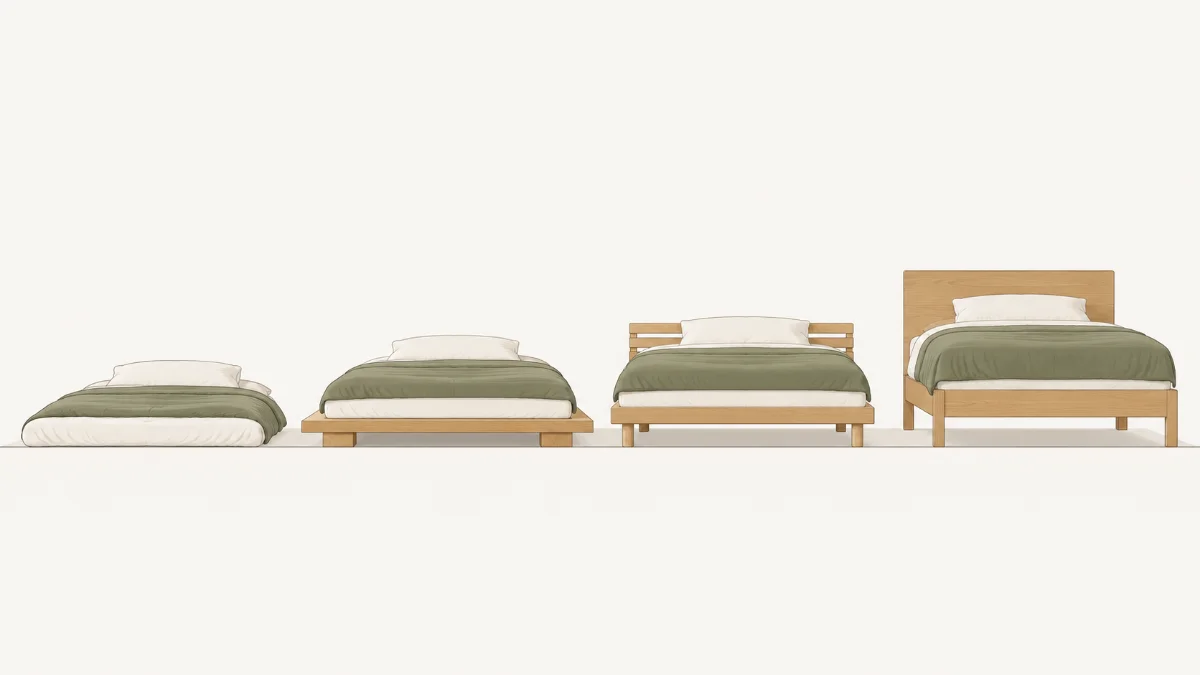
A standard bed is usually about 64 cm (25 in) from the floor to the top of the mattress, according to Casper's bed height guide. A platform bed with a mattress is often closer to 46 cm (18 in), says Nolah. Most Japandi bedrooms sit at or below that platform height.
Remember that the height you see is the frame plus the mattress. Mattresses are often about 28–38 cm (11–15 in) thick, according to Nectar. So a thick mattress on a "low" frame can end up looking like an ordinary bed. If you want the low look, a thinner mattress often helps more than a lower frame.
| Bed setup | Rough height to mattress top | How it looks | What to watch |
|---|---|---|---|
| Futon or mattress on the floor | Mattress thickness only | Most traditional | No airflow underneath. Hardest to get up from. |
| Low platform bed | Around 46 cm (18 in) with a mattress | Low and clearly Japandi | Check the gap underneath for cleaning |
| Low slatted frame on legs | Similar to a platform | Lighter, more open | The best airflow of the low options |
| Standard-height bed | About 64 cm (25 in) | Less striking | Easiest to get in and out of |
Here's a simple test. Sit on the edge of a bed at the height you're thinking about. Bed guides such as Casper's suggest a height where your feet rest flat on the floor and your knees bend at about a right angle. If you have to push yourself up with your hands, the bed is probably too low for everyday use.
2. Floor-Level Sleeping: Pros and Cons
Most people picture a Japanese bedroom as a futon on tatami, a woven straw mat. What the picture leaves out is the daily routine. A traditional futon is folded away each morning. That airs it out and clears the floor for the day. A thick Western mattress left on the floor all week is a different thing.
Pros
- It's the simplest, closest-to-the-floor look a bedroom can have
- There's no frame to buy, move or carry up narrow stairs
- Nobody can fall far, which some parents like in a child's room
Cons
- Little or no air moves underneath, so moisture from your body and the room can collect on the underside
- Floor dust is closer to your face, especially on carpet
- It's harder to get up from
- Many mattress makers advise against it, and it may affect the warranty
Saatva's guide to floor mattresses suggests propping the mattress against a wall at least once a week so both sides can air out. It also suggests a hard floor rather than carpet. That's easy with a thin futon. It's much harder with a heavy queen mattress.
A thin slatted base or a low tatami-style platform is a good middle ground. It keeps the bed almost at floor level but lifts the mattress enough for air to move.
3. What to Look For in a Japandi Bed Frame
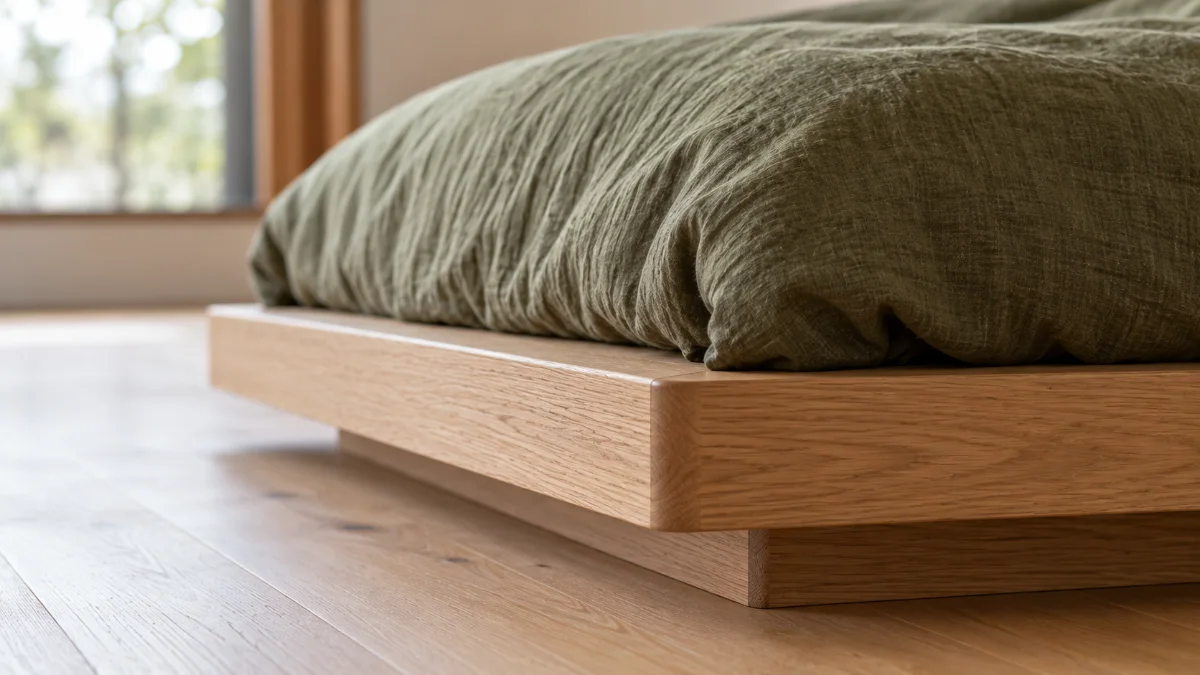
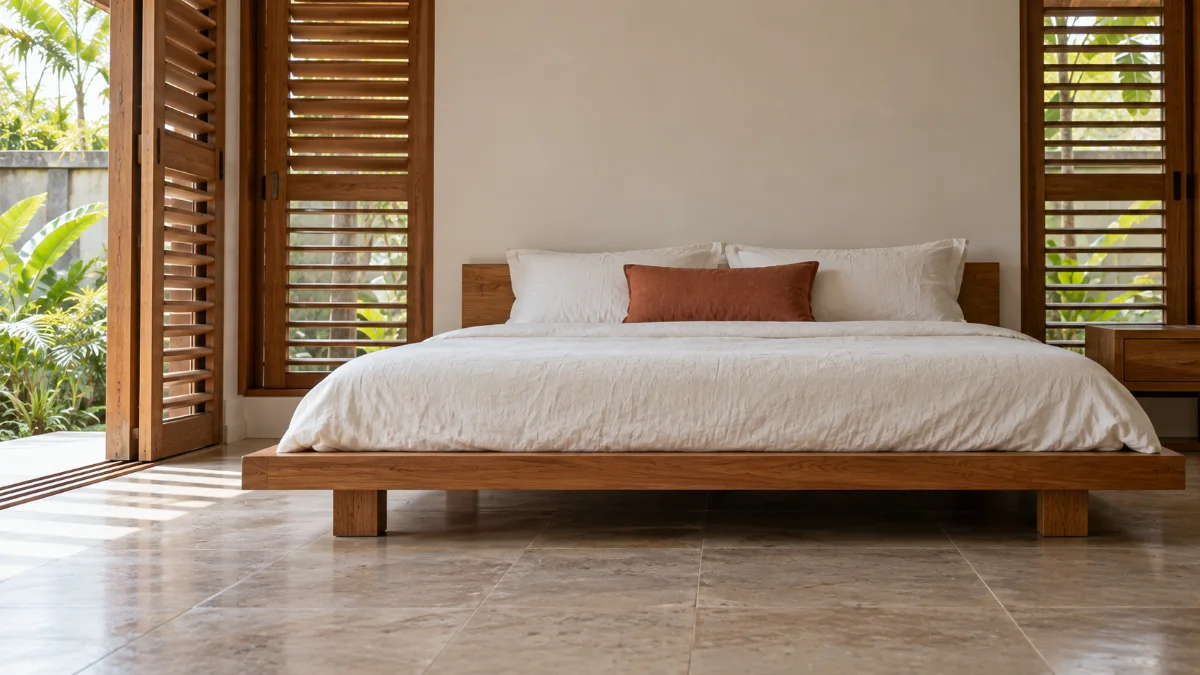
Plenty of beds sold as Japandi are ordinary low beds with a thick padded headboard. A Japandi bed frame is usually simpler than that. Look for a plain shape, visible wood grain and softly rounded edges. A matte oil or lacquer finish fits the style better than a high-gloss one.
Light woods such as white oak and ash keep a small room bright. Walnut and teak look deeper and richer. They suit a larger room, as long as the walls and bedding stay light. A low headboard, or none at all, leaves more wall showing. That can make the ceiling feel higher. Legs set back from the corners can make the bed look as if it's floating just above the floor.
When you shop, try search terms like "low wood platform bed", "slatted platform bed frame" or "solid oak low bed". Check the slat spacing your mattress maker recommends before you buy the frame. If you're keeping other wood furniture, our guide to bedroom ideas with wood furniture shows how to mix the tones.
One trade-off is worth knowing. Some platforms stick out well past the mattress, like a wide ledge. They look lovely in photos, but they make the bed wider, and you can hit your shins on them at night. In a tight room, a frame only slightly larger than the mattress usually makes more sense. The space you need around the bed is covered in our warm minimalist bedroom ideas.
4. Low Platform Bed Bedroom Ideas for Humid Rooms
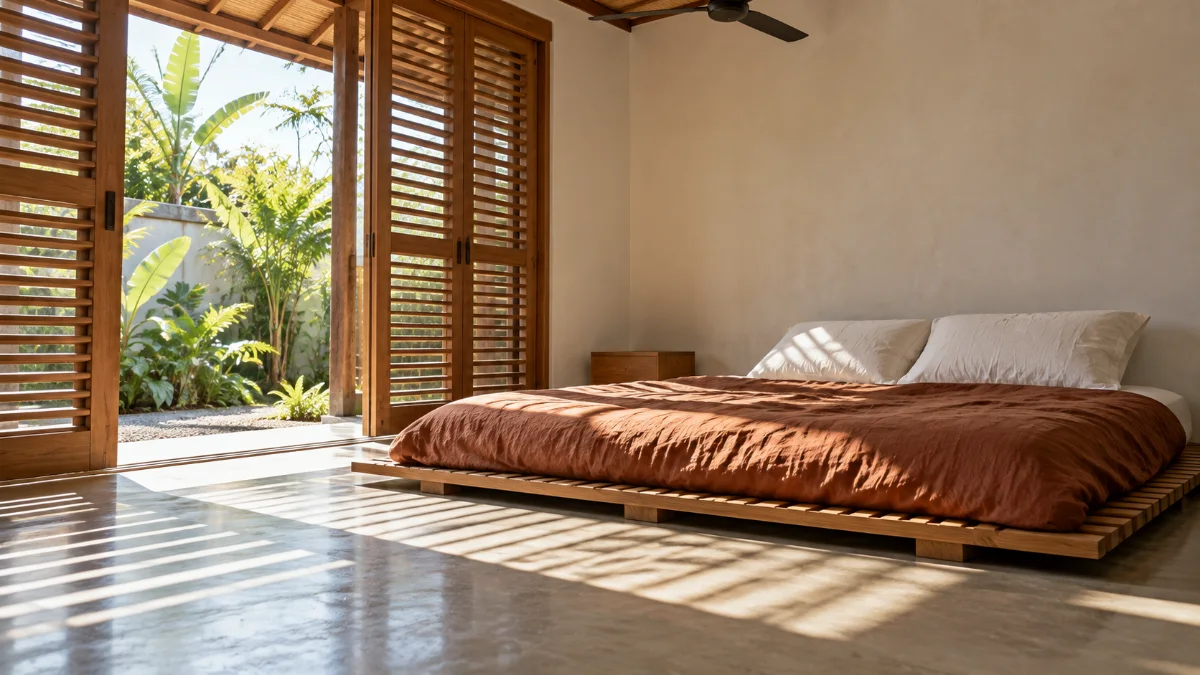
In a humid bedroom, a low slatted bed with open space underneath is generally easier to ventilate and inspect than a solid platform. The same goes for a mattress on the floor. Keep the area under the bed empty, so air can move and you can check for mold.
This matters all year in places like southern Florida, and during long, sticky summers along the Gulf Coast.
Choose slats over a solid board. Choose a mattress protector that doesn't block airflow more than it needs to. Every few weeks, lift a corner of the mattress and look at the underside. And skip under-bed storage boxes. They look tidy, but they block air and make the space harder to clean.
Where you put the bed matters too. Water from the air can form on cold outside walls. This is called condensation. A bed pushed tight against a wall like that is more likely to stay damp. The furniture for a humid climate guide covers indoor humidity levels and drying out a room.
Cold climates have the opposite problem. In a Helsinki or Chicago winter, the air near the floor is the coldest in the room. So a very low bed can feel chilly. A wool rug beside the bed, or a frame on slightly taller legs, can help.
If the room already smells musty, fix the moisture first. A new bed frame won't fix a damp room.
5. Let the Bed Be the Only Big Piece
Bedrooms collect furniture slowly. First a dresser. Then a chair that turns into a clothes pile. Then a bench at the foot of the bed. Japandi works against that.
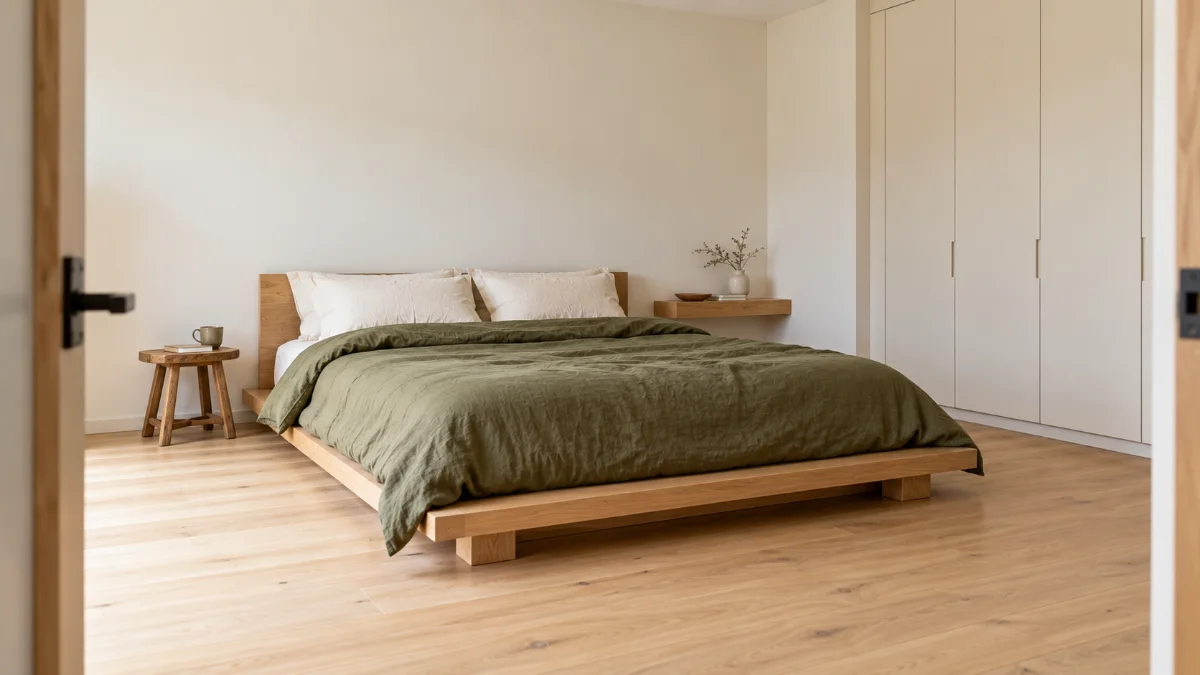
The most useful Japandi bedroom furniture is a short list. You need the bed, somewhere to put a book and a glass of water, and closed storage for clothes. Bedside pieces don't have to match. A low wooden stool on one side and a small wall shelf on the other can look more relaxed than two matching cabinets.
With a low bed, people often forget about height. A standard nightstand can look too tall next to a low mattress. Low side tables, stools or floating shelves often look better. Nightstand height compared with the mattress is covered in our guide to planning the bedside in a warm minimalist bedroom.
For clothes, choose a wardrobe with flat fronts, push-to-open doors or cane panels. Cane is woven rattan, and it adds texture without a busy pattern.
6. Japandi Bedroom Colors
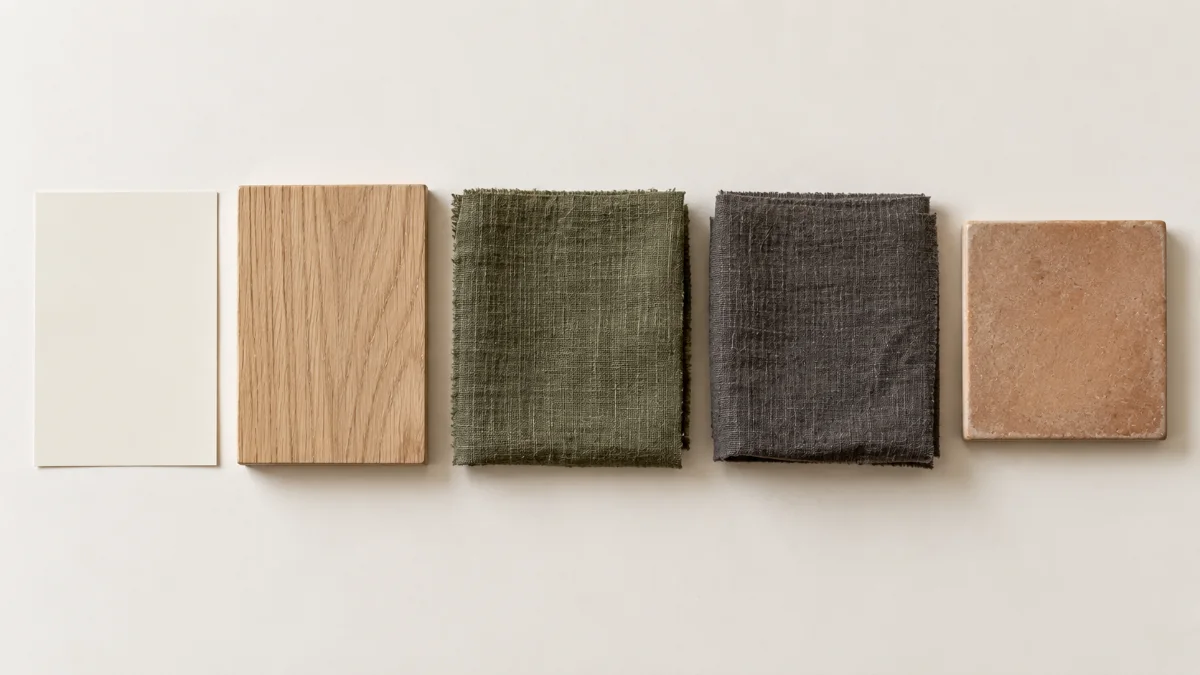
Japandi bedroom colors are usually a warm, light neutral on the walls, one main wood tone and one muted accent. Good accents include sage, clay, charcoal and indigo. Keeping to three or four similar colors gives your eyes less to take in at bedtime.
Here are a few combinations that tend to work.
- Warm white walls, white oak and a moss-green duvet
- Putty walls, walnut and charcoal linen
- Clay limewash, teak and rust cushions
- Soft gray walls, ash furniture and indigo bedding
Limewash is a paint made from lime. It has a soft, slightly cloudy finish.
Light changes all of these colors. A north-facing room in Seattle or Amsterdam can make cool grays look flat and dull. Warmer whites and putty often look better there. In a bright, sunny room, a slightly deeper wall color can cut glare. The living room color schemes guide explains how daylight changes paint and how to test samples.
7. Natural Materials and Bedding You Want to Touch
Wood is the obvious place to start. But a room where every surface is the same oak can feel like a showroom. Mix wood with linen, cotton, wool, paper, ceramic and cane. Keep the differences in texture rather than in color.
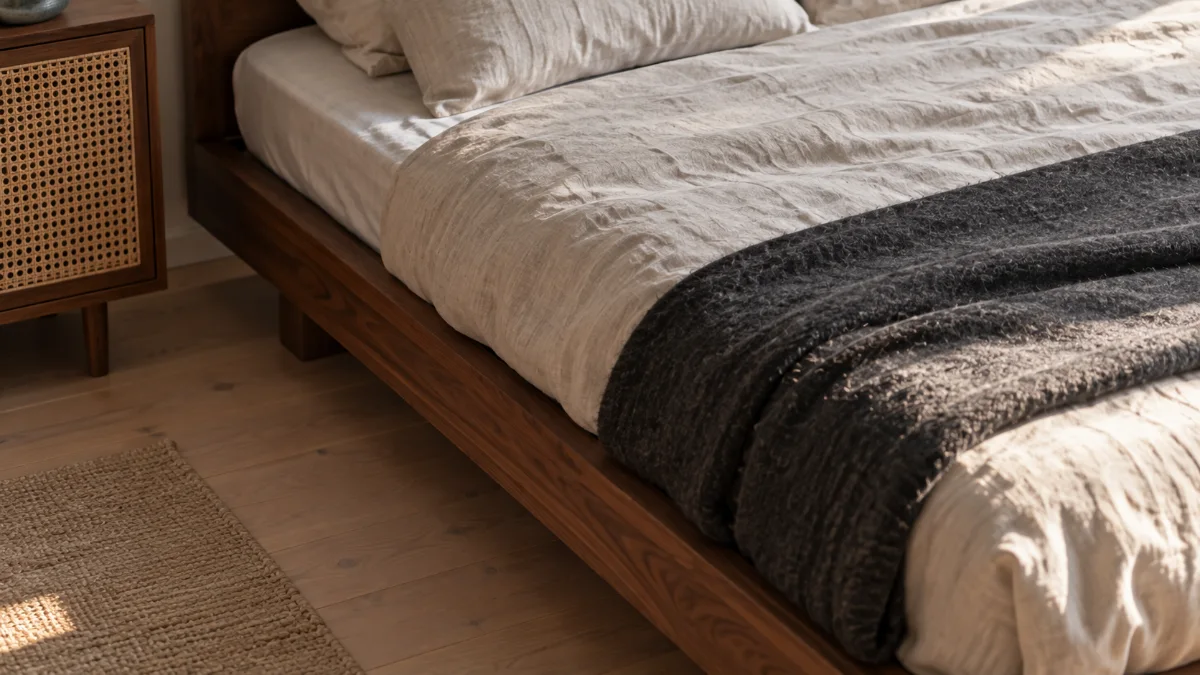
Most of that texture comes from the bedding. Washed linen or cotton in two similar shades is usually enough, plus a duvet and one folded throw. Linen wrinkles, and that's fine. A slightly rumpled bed often looks more natural in a Japandi room than a tightly made hotel bed. Linen or percale cotton can feel cooler in warm months, and a wool blanket adds warmth in cold ones.
Darker wood works too. A walnut bed with oatmeal linen and a charcoal wool throw feels deeper and a little more Scandinavian. Just keep the walls light enough to balance the dark wood.
8. Soft Light Through Paper and Screens
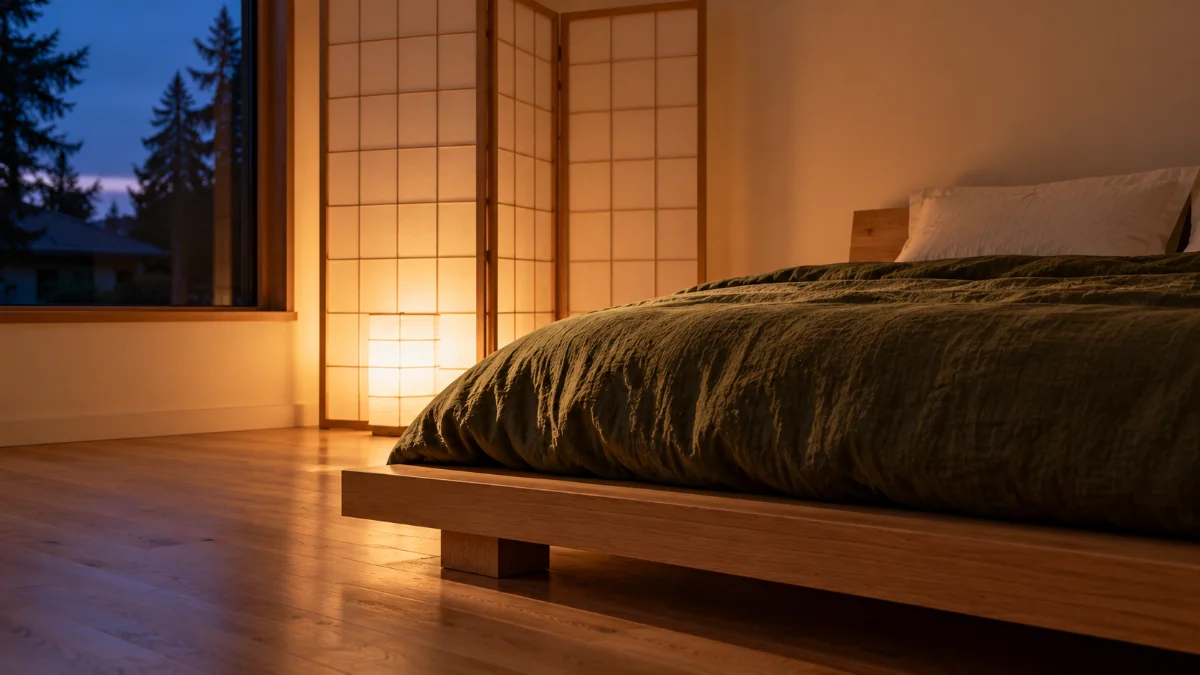
A paper screen is one of the most useful pieces in a Japandi bedroom. A shoji-style folding screen is a light wooden frame covered in paper. Put one beside a window, and it softens harsh daylight. It can also hide a desk or a laundry corner. In an open studio, it can separate the bed from the front door.
In the evening, a lamp with a paper or linen shade suits a low bed. Keep it at about mattress height rather than choosing a tall lamp. A pendant hanging over a very low bed can look lost in the air. Bedside lighting heights are covered in our warm minimalist bedroom ideas. Bulb color is covered in the living room lighting guide.
9. Small Japandi Bedroom Ideas
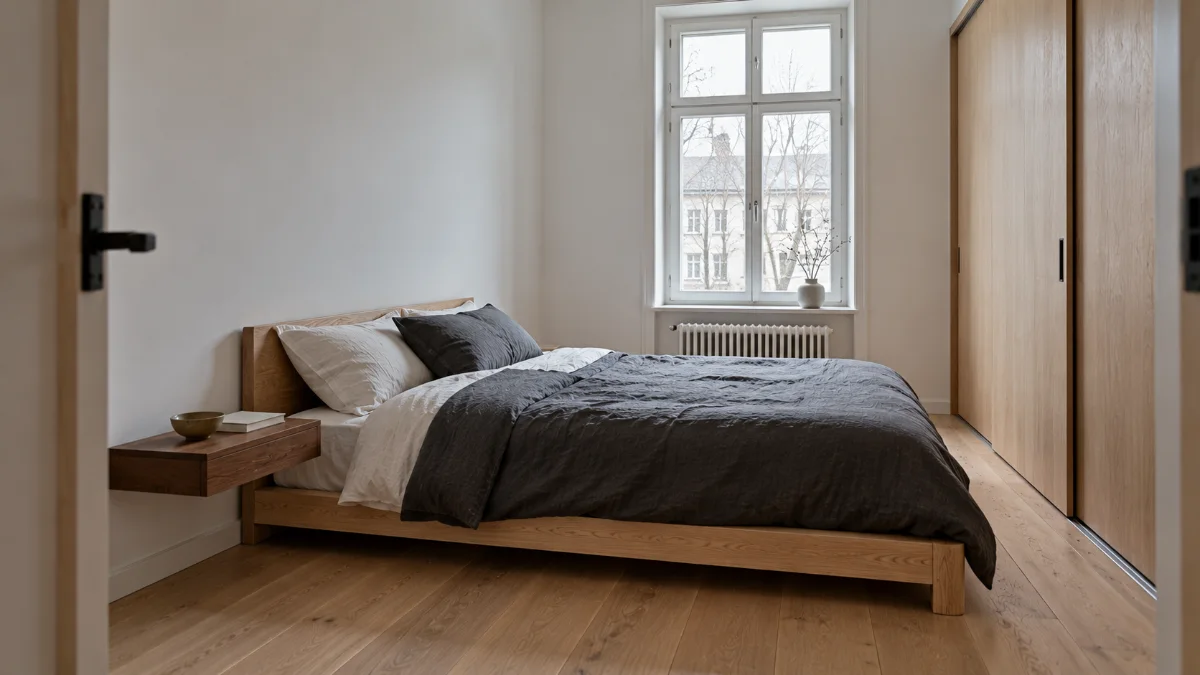
In a small Japandi bedroom, choose a low bed without a deep headboard. Put bedside surfaces on the wall, and keep clothes behind closed doors. That way, most of the floor stays clear.
A low bed helps most in a small room. It leaves more wall showing above the mattress, which can make the room feel taller. Sliding wardrobe doors save the space a hinged door needs to swing open. And leaving one wall completely bare gives your eyes somewhere to rest.
In a very narrow room, the bed may need to go against a wall. Our small bedroom layout ideas cover narrow rooms and box rooms. Think of a New York walk-up, or the second bedroom of a small city apartment. This frees up floor space. But you can only get in from one side, and making the bed is more awkward. That's a fair trade in a guest room. It's less fair for a couple.
Final Thoughts
A Japandi bedroom depends less on decoration and more on getting the bed right. After that, you can mostly leave the room alone.
Here's an easy place to start. Measure your current bed from the floor to the top of the mattress, then sit on the edge. That number, and how it feels to stand up, tells you how low you can comfortably go.